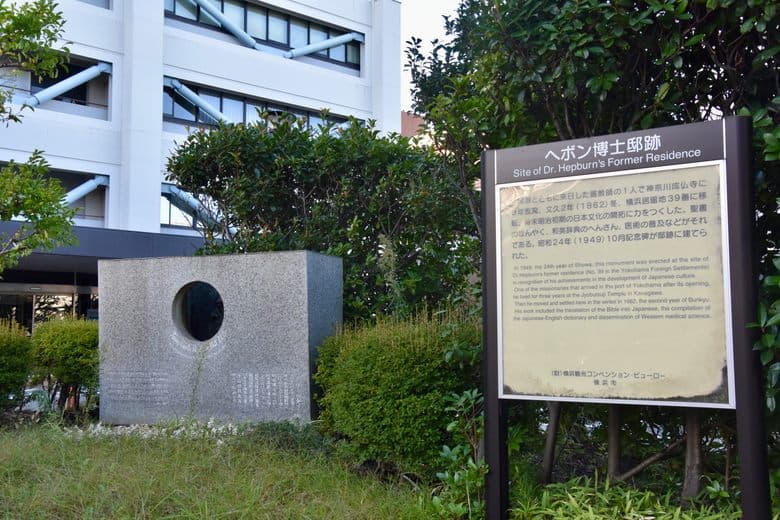
The site of Dr. Hepburn’s Former Residence in Yokohama commemorates Dr. James Curtis Hepburn, an American medical missionary who played a pivotal role in bridging Japanese and Western cultures. He is most renowned for compiling the first comprehensive Japanese-English Dictionary and for developing the Hepburn romanization system, which remains influential in transliterating Japanese into the Latin alphabet. This location serves as a quiet tribute to his significant linguistic and educational contributions during his time in Japan from 1859 to 1892.
Visitors interested in the history of language, early foreign settlements in Japan, or the origins of institutions like Meiji Gakuin University and Ferris University will find this spot meaningful. While not an elaborate museum, the historical marker and relief portrait offer a tangible connection to a figure whose work profoundly impacted Japanese language studies globally. Reviewers often note that it's a place for quiet reflection rather than a bustling attraction, appealing to those who appreciate historical depth over grand displays.
Practical advice for visiting includes setting aside a short amount of time, perhaps 15-30 minutes, as it is primarily a commemorative plaque. There are no facilities or extensive exhibits. It is best visited during daylight hours. Since it's located in a busy area, combining a visit here with other activities in Motomachi-Chūkagai, such as shopping or dining, is recommended. There are no specific items to bring, but a camera might be useful for those wishing to document the historical marker.
To reach Dr. Hepburn’s Former Residence, visitors can utilize Yokohama's efficient public transportation. The site is located off the limelight of the bustling Motomachi-Chūkagai area. The nearest station is Motomachi-Chūkagai Station on the Minatomirai Line, from which it is a short walk. Alternatively, visitors can take a train to Ishikawacho Station on the JR Negishi Line and walk through the Motomachi shopping street. Given its central location, driving is generally not recommended due to limited and expensive parking; public transport or walking is the most convenient option.
Common complaints are that the site is very small and can be easily missed if one is not specifically looking for it. Some visitors express disappointment if they expect a full-fledged museum or a grand residence. To mitigate this, it's important to set expectations correctly: it is a historical marker and a portrait, not a building or extensive exhibition. Approaching it as a brief, educational stop within a larger exploration of Yokohama will enhance the experience.