The Yakuso-Jinshi, also known as the Hippocratic Shrine, is a small but historically significant site in Kyoto. Established in 1858 and rebuilt in 1906, it stands as a testament to the syncretic nature of Japanese religious practices, honoring not only the traditional Japanese medical deities Ōkuninushi and Sukunabikona, and the Chinese god Shennong, but uniquely, also the ancient Greek physician Hippocrates. This blend reflects a period in Japanese history when Western medical knowledge was being introduced and integrated into local culture, making it a fascinating spot for those interested in cultural exchange and the history of medicine.
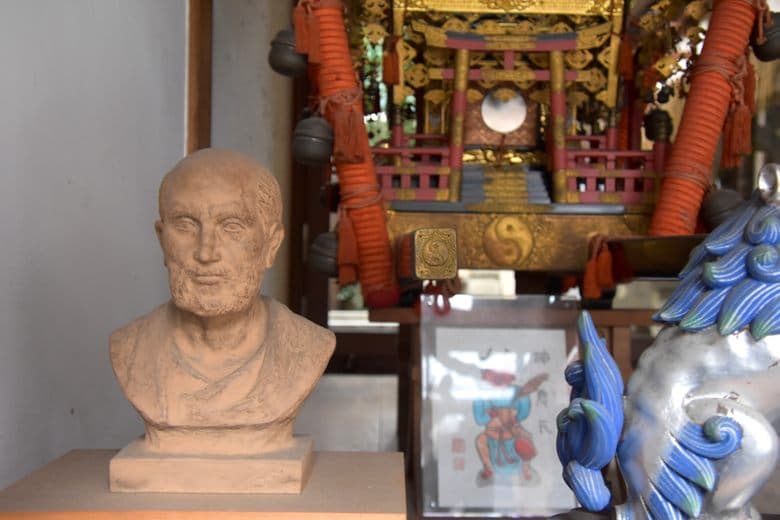
Visitors consistently note the shrine's small size and its somewhat hidden location among traditional houses. The main worship area is generally not accessible to the public, except during a special medical festival in November. However, the interior, which houses mikoshi palanquins, guardian dog sculptures, a statue of Shennong, and notably, a bust of Hippocrates, can be viewed through a protective glass. Reviewers often express surprise and intrigue at finding a Greek figure revered in a Japanese shrine, highlighting its unique appeal as a cultural curiosity rather than a grand architectural marvel.
Given its size, visitors typically spend only a short amount of time here, often less than 15-30 minutes, primarily for observation and reflection. There are no specific items to bring, and it's best visited during daylight hours for clear viewing through the glass. As it's a quick stop, combining it with other nearby attractions in the Higashi-Tamaya area is recommended to make the most of your time.
The shrine is located in the Higashi-Tamaya town of Kyoto. While specific public transport lines are not frequently mentioned in reviews, Kyoto's extensive bus network and subway system can get you to the general vicinity. From a major station like Kyoto Station, you would likely take a bus or subway to a stop within walking distance of the Higashi-Tamaya area. Given its residential setting, walking from the nearest public transport stop is the most probable mode of access. Parking is unlikely to be available directly at the shrine due to its small, urban location.
The primary 'complaint' or observation from visitors is its small size and the inability to enter the main worship area. To mitigate this, adjust your expectations; approach it as a brief, interesting cultural discovery rather than a major attraction requiring extensive exploration. Its value lies in its unique historical narrative and the unexpected cultural fusion it represents.