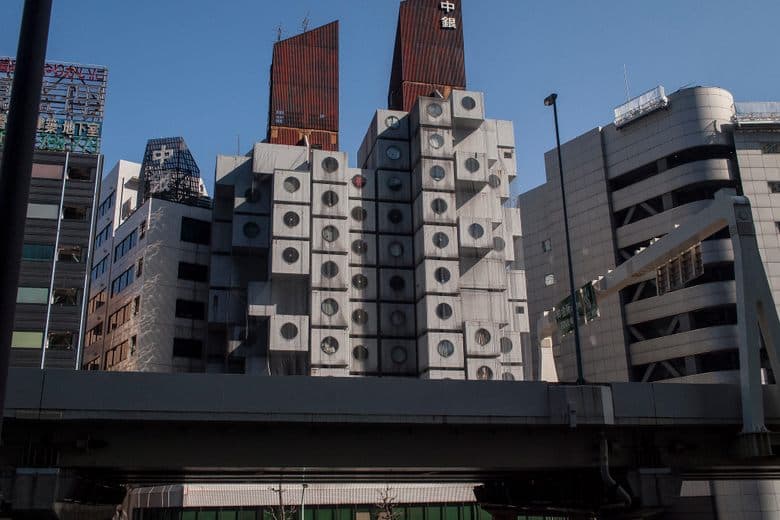
The Nakagin Capsule Tower, completed in 1972, was a groundbreaking example of Metabolist architecture, a post-war Japanese architectural movement that envisioned cities as dynamic, organic entities. Designed by Kisho Kurokawa, it consisted of two main towers supporting 140 prefabricated, self-contained capsules, each intended as a tiny apartment for bachelor salarymen. The innovative concept allowed for individual capsules to be replaced, theoretically updating the building over time. It was celebrated by the international architectural community as a masterpiece of modular design and adaptability.
Unfortunately, as of June 2022, the Nakagin Capsule Tower has been demolished. While it was once a popular destination for architecture enthusiasts and those interested in urban planning, there is no longer a physical structure to visit. Prior to its demolition, visitors often praised its unique aesthetic and historical significance, noting its stark contrast to modern Tokyo's urban landscape. However, practical concerns about the small living spaces and the building's deteriorating condition were also frequently mentioned.
Given its demolition, there is no practical advice for visiting the Nakagin Capsule Tower. Previously, those interested in its history and design would have spent time appreciating its exterior and perhaps seeking out information about its interior. Now, any engagement with the tower must be through historical documentation, photographs, and architectural studies.
As the building no longer exists, information regarding public transport, driving, or parking is irrelevant for current visitors. Its former location was in the Ginza district of Tokyo, an area well-served by public transportation, but this is no longer pertinent for experiencing the tower itself.
The primary 'complaint' now is the building's absence. For those who wished to see this architectural icon, the only mitigation is to explore the extensive photographic and documentary records available online and in architectural archives, which preserve its legacy and design principles.