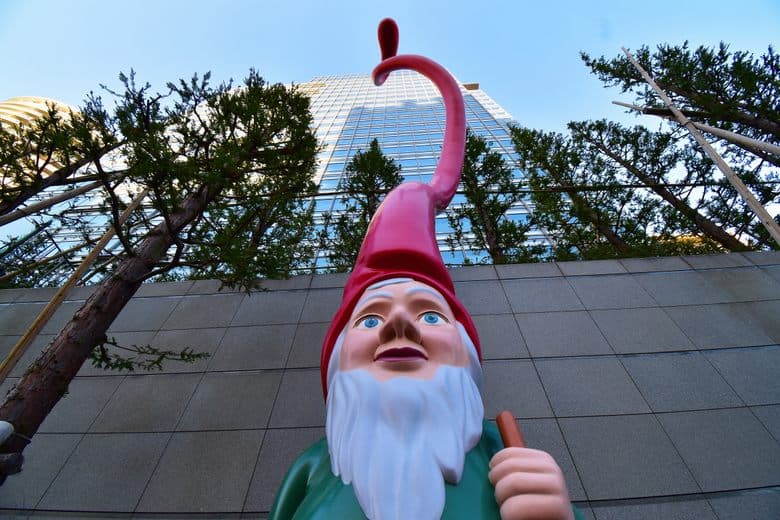
The Growing Gardener is a distinctive public art piece in Tokyo, notable for its colossal garden gnome whose red Phrygian cap extends dramatically skyward. Created in 2006 by the German artist collective Inges Idee, this sculpture was designed to mark the opening of Osaki Art Village, a modern complex of offices and residences. It serves as a playful guardian of the village's garden, embodying the city's unique fusion of the abstract and the tangible, the mystical and the real.
Visitors often express surprise and amusement upon encountering the sculpture, especially those catching a glimpse from passing Yamanote Line trains. Its unusual scale and whimsical nature make it a memorable, if brief, experience. Reviewers frequently highlight the sculpture's ability to provoke a double-take and appreciate its contribution to the urban landscape's quirky charm. There are no consistent complaints about the sculpture itself, though some visitors might find its location within a commercial complex less picturesque than a traditional park setting.
To fully appreciate the Growing Gardener, a visit of 15-30 minutes is usually sufficient. It's best viewed during daylight hours to fully appreciate its vibrant red color and towering height. Since it's an outdoor installation, there's no entry fee. Visitors recommend combining a visit with other activities in the Osaki area, such as exploring the nearby shops or enjoying a meal, rather than making it a standalone destination. There's no specific equipment needed, but a camera is often suggested for capturing its unique appearance.
The Growing Gardener is conveniently located just a few minutes' walk from Osaki Station. Osaki Station is a major hub served by the JR Yamanote Line, Saikyo Line, Shonan-Shinjuku Line, and the Rinkai Line. From the station, follow signs towards the Osaki Art Village or simply look for the distinctive red pillar stretching into the sky. Its proximity to a major train station makes it easily accessible via Tokyo's extensive public transport network, eliminating the need for driving or parking.
While there are no common complaints about the sculpture, some visitors might find its setting within a modern office and residential complex less 'touristy' than other Tokyo attractions. To mitigate this, approach the visit with the expectation of seeing a unique piece of urban art rather than a historical landmark. Combining it with other local activities can enhance the overall experience.