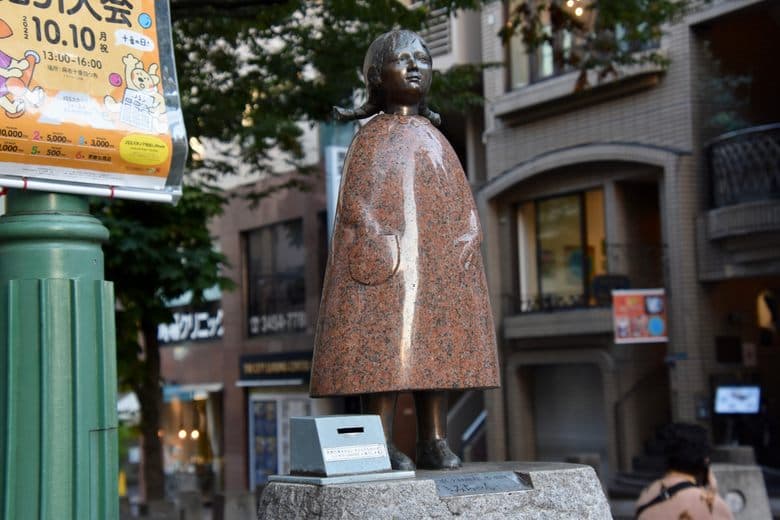
The Kimi-Chan sculpture, located in Tokyo's upscale Azabu-Jūban district, is a memorial to a young girl named Kimi Sano. Her poignant life story is widely believed to be the inspiration behind "The Red Shoes," a beloved Japanese children's song known for its melancholic melody and lyrics. The song tells of a girl in red shoes taken away by a stranger, and while the initial interpretation might suggest abduction, it ultimately reflects on a child sent abroad, never to return. The statue, erected in 1989, stands as a quiet tribute to this enduring piece of Japanese folklore.
Visitors often find the statue to be a subtle and reflective experience rather than a grand attraction. It is appreciated by those who are familiar with the song or the local history, offering a moment of quiet contemplation. Reviewers note that its significance is amplified by understanding the backstory, which adds a layer of depth to what might otherwise appear as a simple sculpture. Some visitors, particularly fans of the classic 1990s anime 'Sailor Moon,' enjoy seeing the statue as it made an appearance in the series, which is set in Azabu-Jūban.
To fully appreciate Kimi-Chan, it is recommended to read up on the story of Kimi Sano and "The Red Shoes" beforehand. The visit itself is brief, typically lasting only 5-10 minutes, as it is a single statue in a small public space. There are no facilities or extensive exhibits. It is best visited during daylight hours. There are no specific items to bring, but a smartphone for quick research on the story can enhance the experience.
The Kimi-Chan statue is situated in the Azabu-Jūban district. The nearest subway station is Azabu-Jūban Station, served by the Tokyo Metro Namboku Line and the Toei Oedo Line. From the station, the statue is typically a short walk, usually within 5-10 minutes, making it easily accessible via public transport. Driving is not recommended due to limited parking in the area.
A common complaint is that without prior knowledge of the story, the statue can seem unremarkable, leading to a sense of disappointment for those expecting a more visually striking or interactive attraction. To mitigate this, ensure you are familiar with the folklore of "The Red Shoes" and Kimi Sano before your visit. It is best viewed as a cultural marker rather than a major tourist sight.